

Zoran Music
Bukovica
1909 -
Venedig
2005
Zoran Music was born on February 12 in Bukovica near Gorizia. After finishing his studies at the art academy in Zagreb Music spent some time in Spain. 1934-1940 Music lived in Maribor. In 1940 he moved to Ljubljana, where he lived until 1943. In October 1943 Music went to Venice. One year later Music was arrested in Venice and deported to Dachau where he franticly sketched the life in the camp under extremely difficult circumstances. After his liberation in 1945 Music returned to Venice.
The first solo exhibition was shown in Venice in 1946. In 1950 Zoran Music won the first prize at the Bienniale in Venice. Other prizes followed in 1951 and 1952 when Music was awarded the Prix de Paris, first together with Corpora and then alone. A new beginning in painting evolved around the artist's preoccupation with the Dalmatian landscape. A next step was an awakened interest in his direct environment, Italian landscapes. Stylistically he was influenced by Byzantian mosaics and icons. He also spent some time during the 1950s working in Paris where the 'lyrical abstraction' of the French Informel determined the art world. He kept his studio in Venice, however, and exhibited again at the Biennale in 1956 and 1960. This time the artist was awarded the great prize for his graphic work and the UNESCO Prize. During the 1960s his organic motifs became more and more abstract and his compositions abandoned the laws of three-dimensionality. The much acclaimed series 'We are not the Last', in which the artist transformed the terror of his experiences in a concentration camp into documents of universal tragedy, was made in the 1970s. Music's work has been honoured in numerous international exhibitions, such as the large retrospective exhibition at the Grand Palais in Paris in 1955.



Would you like to sell a work by Zoran Music?
Infos for seller


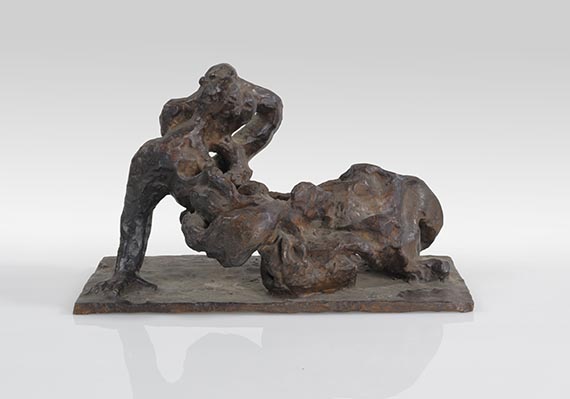
Starting bid: 4,500 EUR